
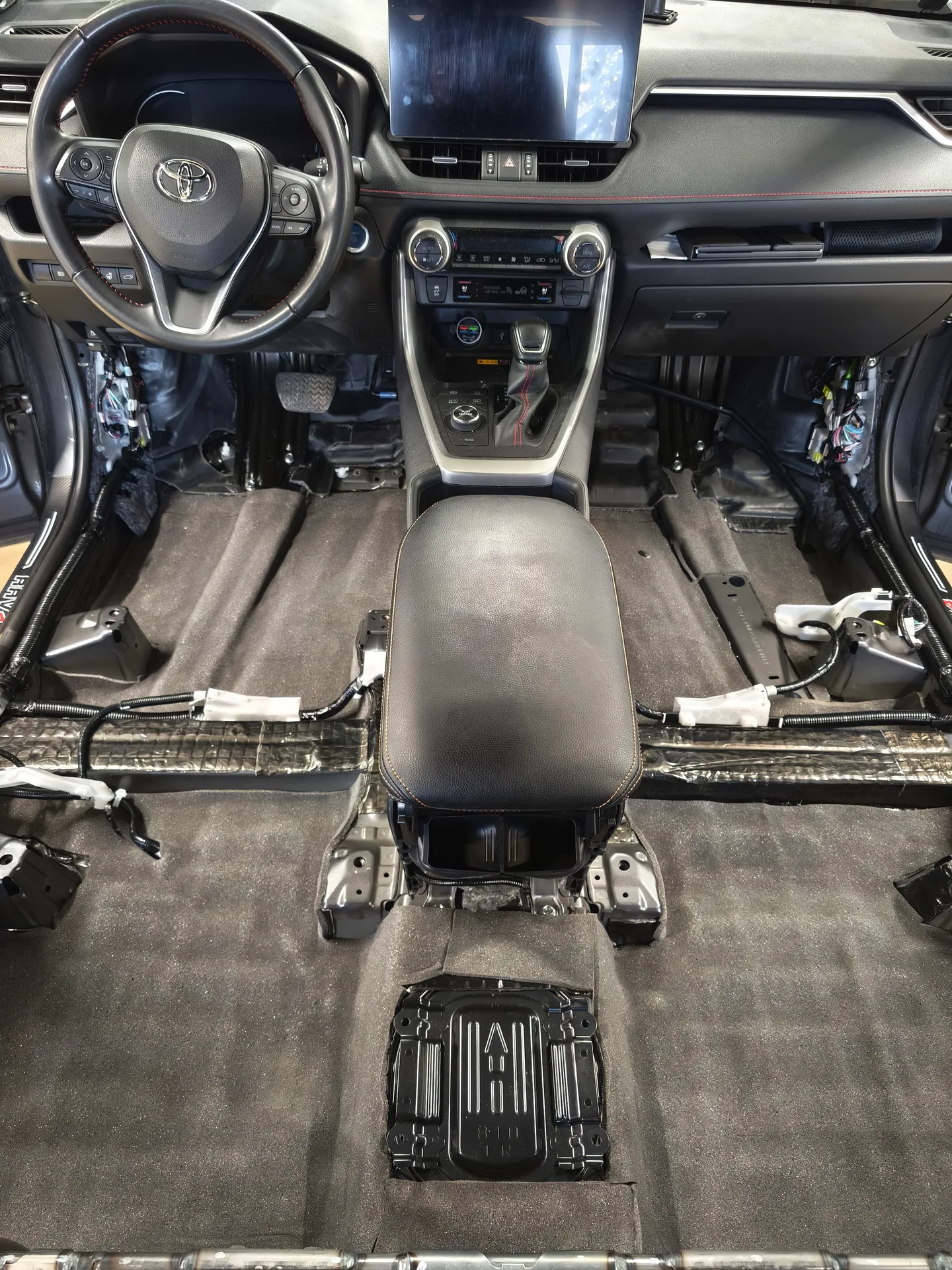
Unfortunately, many car components tend to vibrate and become additional sources of noise. This problem can be reduced with properly selected soundproofing materials, significantly improving cabin comfort.
When we do soundproofing, we aim to find the best combination of materials based on three criteria: price, weight and result. Our goal is to achieve maximum effectiveness with a moderate increase in vehicle weight and at a reasonable cost.
For everyday vehicles, we combine vibration dampers from different price and weight categories. The most critical areas — wheel arches, the front floor and the hood — are covered with the highly effective, but also heavier and more expensive, Silent Coat Extra 4 mm. All other metal surfaces — the roof, trunk, doors, and front and rear fenders — are covered with the lighter Silent Coat 2 mm.
On top of the vibration damper, we always install either a sound insulator or a sound absorber. When a client expects an even higher level of refinement, we use a “sandwich” structure: vibration damper, sound insulator, sound absorber.
Roof
As a rule, the roof and wheel arches are among the least insulated areas in a car. Other areas usually just have weak factory insulation. In most vehicles — and especially in SUVs and wagons — the roof is a large sheet of metal that acts like a diffuser, transmitting its own vibration directly into the cabin. Tap on the roof and imagine what airflow does to it at highway speed. You are practically sitting inside a drum.
To neutralise this effect, after cleaning we cover the entire inner roof surface with Silent Coat 2 mm. On top of that, we install either Isolator 6 mm or Absorber 15 mm.
Engine Bay
The hood should be covered with Silent Coat vibration damping material and then with either 15 mm or 35 mm sound-absorbing material. Before installation, the hood is thoroughly cleaned and degreased. If factory hood insulation is present, it is carefully removed beforehand and reinstalled after the work is complete.
After that, we treat the firewall from the cabin side as extensively as possible without removing the dashboard. Taking the dashboard apart usually does not justify the extra labour relative to the result. In most cases, we can cover about two thirds of the metal. Here we use either Silent Coat Extra 4 mm or Silent Coat 2 mm. Where possible, we add a further layer of sound insulation on top to suppress residual noise that still passes through the firewall.
Floor
First of all, we need to isolate the cabin from external noise that comes through the metal. The floor is covered with Silent Coat or Silent Coat Extra sheets — Silent Coat Extra offers roughly twice the damping performance of standard Silent Coat. On top of that, we add either 15 mm sound absorber or 4–10 mm sound insulation.
Trunk
The trunk floor can be covered over 50% to 90% of its surface. The wheel arches are one of the strongest noise sources in a car, so they deserve special attention. We recommend using Silent Coat Extra as the vibration-damping layer and then installing 35 mm sound absorber on top. The trunk lid is treated in much the same way as the hood.
Doors
Around 70% of the outer door skin — the metal panel closest to the street — is treated with Silent Coat. We also seal all openings in the inner panel with Silent Coat to improve speaker performance. After that, the door cards are covered with 15 mm sound-absorbing material.
Front Wheel Arches and Fenders
Without removing interior trim, it is difficult to eliminate noise from the front wheels completely. In our experience, treating the front wheel arches from the outside and covering the front fenders with even the lightest Silent Coat material already produces a noticeable improvement.
The work described above on a mid-size car such as a Honda Civic, Toyota RAV4 or Mazda 6 takes about 32 hours, or two working days for a two-person team.